
CMU Researchers Use AI To Explore How Alzheimer’s Changes Brain Cells
Media Inquiries
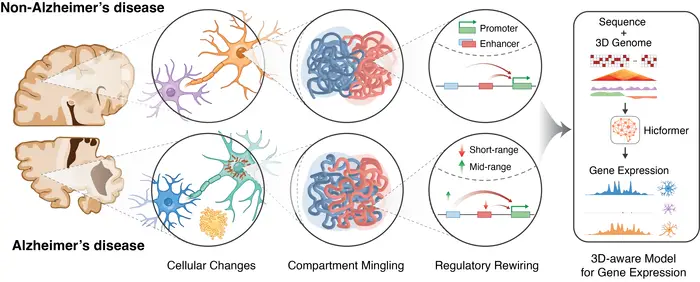
In brain cells affected by Alzheimer’s disease, DNA is physically arranged differently inside the cell — a change linked to differences in which genes are active, according to research led by Carnegie Mellon University. The findings, published in the journal Science, offer new insight into how changes in the arrangement of DNA may contribute to the disease, the most common cause of dementia.
Jian Ma(opens in new window), the Ray and Stephanie Lane Professor of Computational Biology who led and supervised the study, said that understanding the disease requires looking beyond changes in individual genes to consider how the genome is organized as a whole.
“Alzheimer’s disease cannot be understood one layer at a time,” Ma said. “The genome’s 3D structure is a fundamental regulatory layer that helps to connect DNA sequence to gene activity. By integrating genome folding, cell state and tissue context, we can move beyond cataloging disease-associated changes toward understanding how they fit together and which mechanisms to test next.”
Looking at Alzheimer’s at the individual cell level
To build this multiscale view, researchers analyzed postmortem tissue from the prefrontal cortex obtained from individuals with and without Alzheimer's disease who participated in a long-term study on dementia and donated their brains to science after death. They used GAGE-seq, a method that measures which genes are active and which regions of DNA are close together in the same cell.
Once they mapped how DNA was arranged inside these brain cells, the researchers saw that certain regions of DNA were coming in contact with each other in an unexpected way.
Researchers from Carnegie Mellon University's School of Computer Science(opens in new window) led the study and worked with colleagues at several other institutions, including the University of Pittsburgh School of Medicine and the University of Washington.
“Our study represents a major advance in understanding what goes wrong in Alzheimer’s disease,” said Hansruedi Mathys, assistant professor of neurobiology in Pitt’s Department of Neurobiology, who directed the Pitt arm of the study. “We know the classic hallmarks of Alzheimer’s disease — accumulation of amyloid-beta plaques and tau tangles — but our results establish higher-order chromatin alterations as a component of the molecular pathology associated with the disease, which currently affects 7 million Americans, a number that continues to grow.”
AI helps connect DNA structure to gene activity
To better understand how changes in DNA organization relate to gene activity, the team created Hicformer, an AI model that combines DNA sequence and information about how DNA is folded to predict which genes are active. Xinyue Lu, a computational biology doctoral student who co-led the research, described the tool as a computational test bed for exploring how changes in genome folding may alter gene activity.
The team also combined these measurements with maps showing where different cells and patterns of gene activity are located in brain tissue.
“Measuring gene activity and genome folding in the same cell allows us to directly connect chromosome structure with disease-related gene programs,” said Yang Zhang, a project scientist in the Computational Biology Department who co-led the research. The approach revealed a consistent pattern of DNA reorganization across several types of brain cells affected by Alzheimer’s disease and helped researchers identify regions of the genome for further study.
By mapping these changes across intact brain tissue, the researchers found that reorganization of the genome was linked to changes in gene activity and in how brain cells were organized. The findings identify 3D genome organization as an important layer of Alzheimer’s biology and provide a framework for future experiments to determine which changes in genome structure contribute directly to the disease and whether they could reveal new therapeutic targets.
This research was supported by grants from the National Institutes of Health. Other CMU authors included doctoral students Shahul Alam and Shike Wang and postdoctoral research associate Junjie Tang. Zhijun Duan, who co-led the project, is a research associate professor at the University of Washington. The team included researchers from the University of Pittsburgh; the Broad Institute of MIT and Harvard; the University of California, Los Angeles; the University of Washington; and the Rush Alzheimer’s Disease Center.


Work That Matters
Researchers at CMU are working on real world solutions to the biggest challenges.
Read more about the latest discoveries.(opens in new window)


