Building the Future: Carnegie Mellon Is the Quintessential American Story
Media Inquiries
An original copy of the Bill of Rights(opens in new window) sits on display inside Carnegie Mellon University Libraries’ Posner Center for Special Collections(opens in new window), a testament to the genesis of the American experiment.
This Constitution Day(opens in new window), Carnegie Mellon will host a symposium launching the university’s America250 programming, which commemorates the sestercentennial of American independence. The offerings(opens in new window) will reflect on the nation’s founding documents while engaging the questions that will shape its future.
The formation, foundation and evolution of Carnegie Mellon is truly an American tale.
“We have gone from a trade school with a muddy campus to one of the leading research universities in the world — and to have done that in 125 years is a really improbable story,” said Julia Corrin, the Michael and Lonna Smith University Archivist and associate dean for distinctive collections at CMU. “To have had ambitions that great, and to have carried it out, is really a microcosm of the American story.”
Pictured above: Howie Choset shows off his star-spangled robot as his snake robot climbs up the leg of former Pittsburgh Steeler Charlie Batch at the America250PA concert. That snake robot was recently instrumental in earthquake search and rescue. Image credit: Joel Thomas Photography
Heart in the work, work from the heart
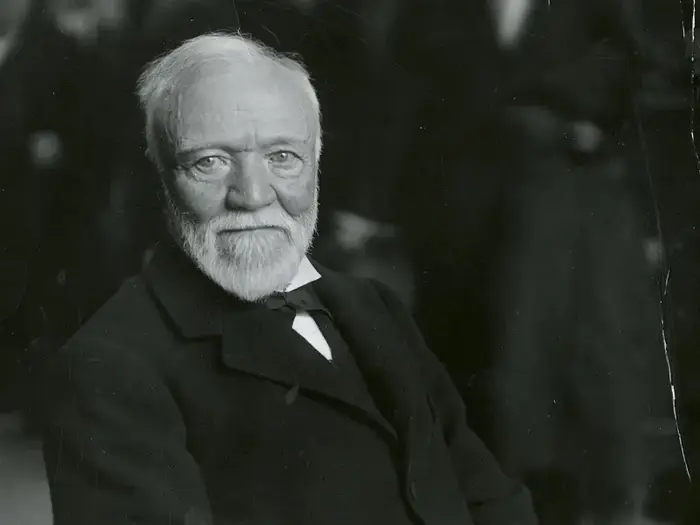
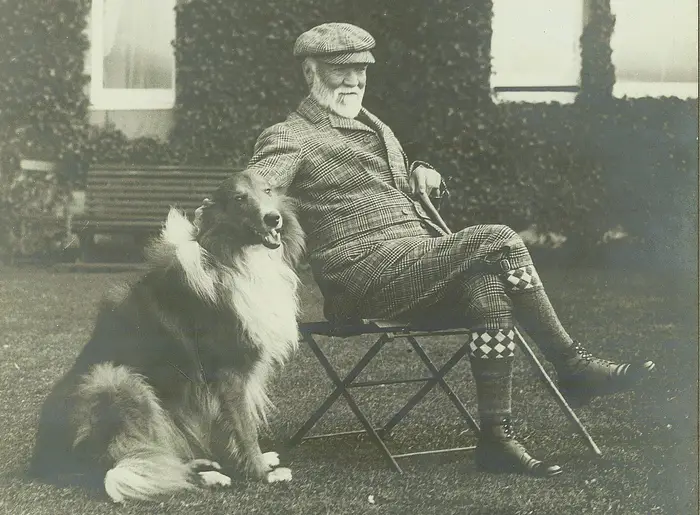
Andrew Carnegie, an immigrant from Scotland, came to the United States in 1848 and settled in Pittsburgh. Rising from textile mill worker to titan of industry, he founded the company that became the world's largest steel producer by the end of the 19th century. Carnegie steel anchors landmarks across the U.S. like the Empire State Building.
As the richest man in the world, Carnegie said, “to die rich is to die disgraced.” He laid a philanthropic foundation for the future with ambitious public-serving institutions like New York City’s Carnegie Hall, nearly 1,700 Carnegie Libraries across the United States, the Carnegie Museums and Carnegie Mellon University.
And while Carnegie may not have envisioned how his legacy would affect both Pittsburgh and the nation (or robots(opens in new window) in Uncle Sam hats with plastic googly eyes taking the stage to the cheers of thousands of fans for that matter), that significant impact continues through the CMU research and revelations improving life for everyday Americans.
Carnegie used the phrase “my heart is in the work” when he wrote to the city of Pittsburgh announcing his donation of $1 million to the formation of a university. Since then, the work of staff, faculty and students from CMU has helped shape the course of U.S. history.
“The old nations of the earth creep on at a snail’s pace; the Republic thunders past with the rush of the express.”
The enduring quality of usefulness
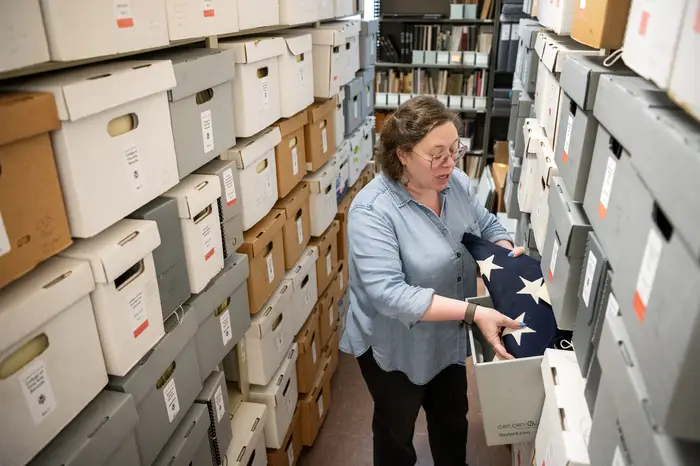
Growing up in Chicago, Corrin wore out her audio cassette of the soundtrack to “Godspell” by playing it on repeat in the background and loved watching “ER.” She knew of Carnegie Mellon, the first school in the country to form a degree-granting drama program(opens in new window), because it had been her mother’s dream school as an actress.
After 12 years as the archivist for the university, Corrin has found much more to love about CMU. She feels even more at home now that Carnegie Mellon alumnus John Wells has brought echoes of his “ER” drama to Pittsburgh(opens in new window).
"I love Carnegie Mellon's story of rapid change, and the unconventional things, traditions (opens in new window)and experiments we've done along the way. You're part of the research just by being on campus," Corrin said. "My first year here, I had a meeting in the Gates Hillman Center, and as you walk in, you're just like, 'Oh, hi, robots.' This really is a different place."
Corrin is presently hard at work completing an exhibit for the University Libraries(opens in new window) focused on how CMU shifted footing to aid the war effort during World War I.
“Carnegie Tech was always focused on making and translating what we do into real-world impact. That’s been part of our DNA since day one,” she said. “We have never not done something because we thought it was going to be impossible.”
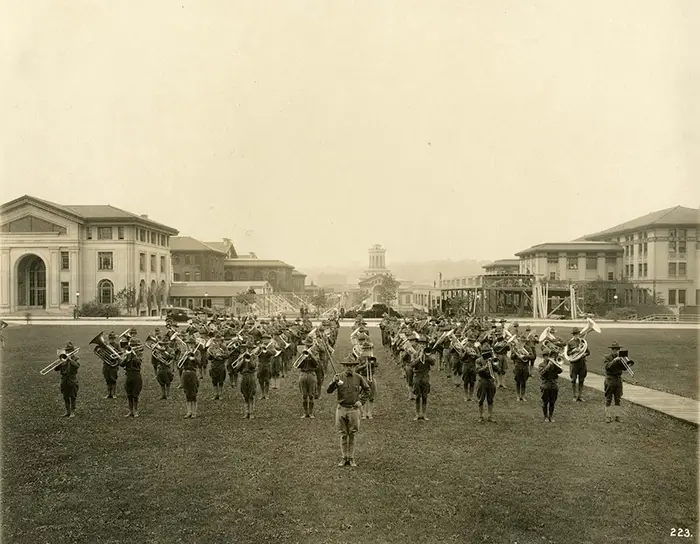
Before WWI, the university's main partnership with the government existed at the local level with the City of Pittsburgh. But when the U.S. realized it needed a large number of soldiers quickly, the War Department turned to colleges and universities as sites to establish training centers. On March 24, 1917, President Arthur A. Hamerschlag(opens in new window) offered the university as one such institution.
"You see this pattern over and over again as we search for real-world answers," she said. "Our government relations work traces back to World War I. It shows how higher education can shape the American experience in ways companies and governments simply can't."
Over CMU’s 126-year history, the story plays out like a well-loved “Godspell” tape on repeat. In 1965, alumna Stephanie Kwolek(opens in new window) made a discovery that led to the creation of Kevlar, which is used today in protective clothing for firefighters and bulletproof vests for soldiers and police officers. This material has saved the lives of law enforcement officers for decades. In 1994, the “Wireless Andrew,” was created to support Carnegie Mellon's wireless research, the first such network anywhere. It laid the foundation for today's Wi-Fi that allows computers and mobile devices to access the Internet anytime, anywhere. In 2009, Researcher Tuomas Sandholm(opens in new window) developed a computer algorithm that accelerates the matching of living organ donors with compatible patients, shortening waits and saving lives.
“That to me is kind of the CMU story we see, we pick out a problem and we fix it. That continues today,” Corrin said. “I imagine it'd be hard to think about America without Carnegie Mellon at this point. That it would be a vastly different place.”
Deeper questions unravel American history
History may not garner the same attention at a university as the research aiming to cure rare diseases or make robots swim. But the value proposition of a history degree is immense, according to Christopher Phillips, professor and head of the Department of History.
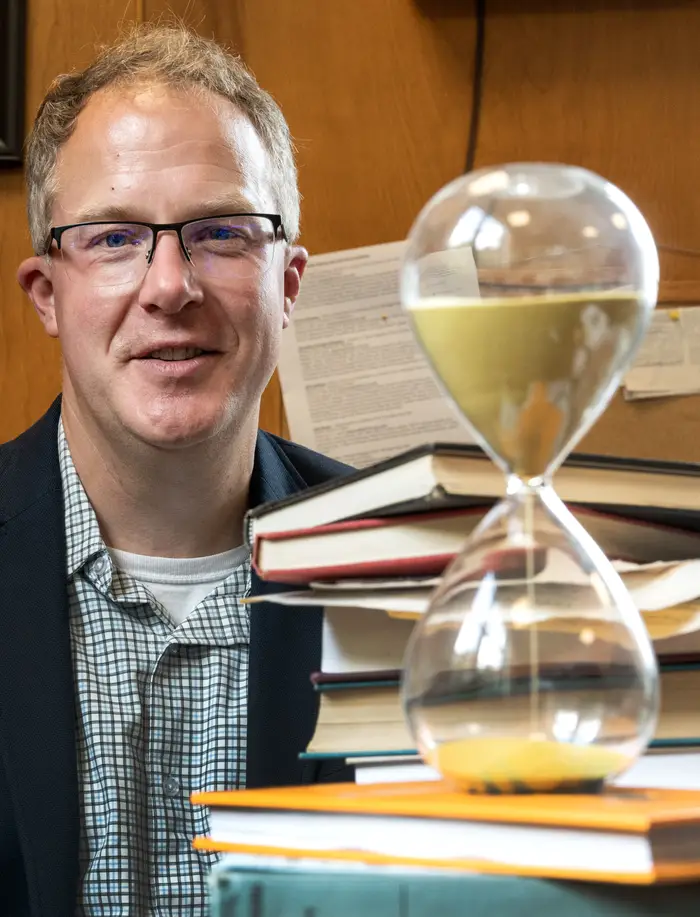
A large stack of books from his current research project on the history of biostatistics obscures the desk in Phillips’ office in Baker Hall. He has various clocks from his collection stashed around the room. A 45-minute hourglass sits on a shelf. Time is always on his mind.
Since January 2025, Phillips has served as head for history in the Dietrich College of Humanities and Social Sciences. The department uses a heavily interdisciplinary approach. Students from across the university add second majors like ethics, history and public policy once they see how CMU’s history faculty teach them how to think critically.
“We've been doing the same kind of innovative, groundbreaking, award-winning research that happens in every department at the university,” said Phillips. “The kinds of skills you learn here will teach you to really thrive throughout a lifetime. Students in every department at CMU want to make the world a better place, but, a lot of the time, the tools they are given are how to tinker with code or how to solve preset problems in science. They're already comfortable with the arts or with technology. What we're trying to do is to think much more about the big picture, and ask much deeper questions.”
For America’s 250th birthday, Phillips has plenty of deep questions.
“These birthdays are moments of reflection, whether it's 2026 or 1976 or 1876. They present opportunities to say, how did we get here? Who are we as a people?” he asked. “You don't hear about birthdays being celebrated in China or in England or these places that trace their history much deeper. Whereas the novelty of this experiment, the novelty of the country, is part of — for better or worse — the story we tell about the United States.”
That story, and how it's told, matters to a critical thinker like Phillips.
“Think of economists or archivists, librarians — many disciplines study the past. Historians tend to be more conservative in our methods,” Phillips said. “We care so much about the quality and reliability of evidence, and so it’s not always obvious how to continue the standards we have for evidence with new technologies. That said, look at the National Archives Digital Preservation Program, something like efforts by some of the nonprofits like the Wayback Machine and Internet Archive. These are going to become critical moving forward because everything's online or it's locked in your cell phone. And so I think one of the things that we have to do as historians is constantly balance how we preserve our standards for evidence and argumentation with how we access evidence.”
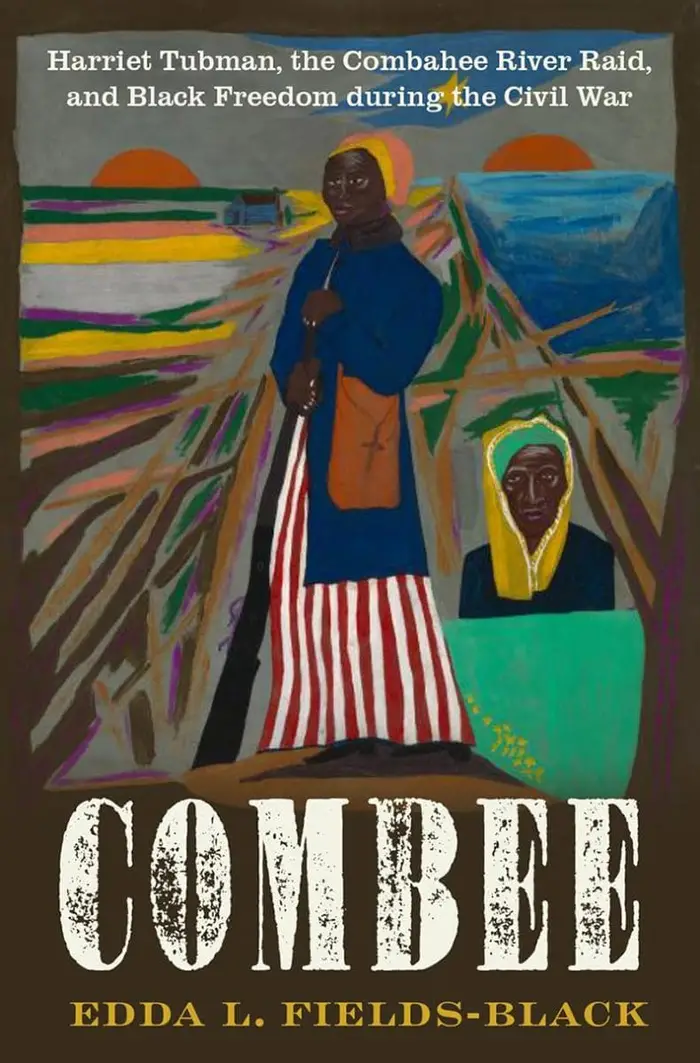
The 250th celebration does provide the opportunity to investigate another deep question: Is there anything new in history? One such project from CMU’s history department recently answered that question with a resounding yes.
In 2025, CMU historian Edda Fields-Black received the Pulitzer Prize in History for her book “COMBEE,” a recounting of a rebellion led by Harriet Tubman that freed 756 enslaved people. Published in 2024, the book is the result of years’ worth of research and recounts the story from the perspectives of Tubman and the previously enslaved people who liberated themselves in the raid. Fields-Black herself is a descendant of one of the participants of the raid.
“There are still new stories to tell about the past, even about subjects as well-researched as Tubman and the Civil War,” Phillips said.

A human‑centered future with profound possibility

What started as a technical trade school looking to improve the lives of factory workers in the Pittsburgh region has grown into one of the top universities in the U.S. Carnegie Mellon researchers continue to address the nation’s most urgent challenges, working to improve daily life for people across America.
Its researchers and experts help shape U.S. policy by engaging with members of Congress on Capitol Hill on the ongoing revolution of artificial intelligence technologies, while preparing new ways of educating the next generation of workers for this changing economy.
Over 500,000 high school students benefit from work on cognitive tutors every year by scholars like John Anderson, Ken Koedinger and others at Carnegie Mellon. That foundation was laid from work from CMU scholars like Herb Simon, the godfather of learning science and learning engineering, and it continues to advance through initiatives like the recently-launched Learnvia collaborative.
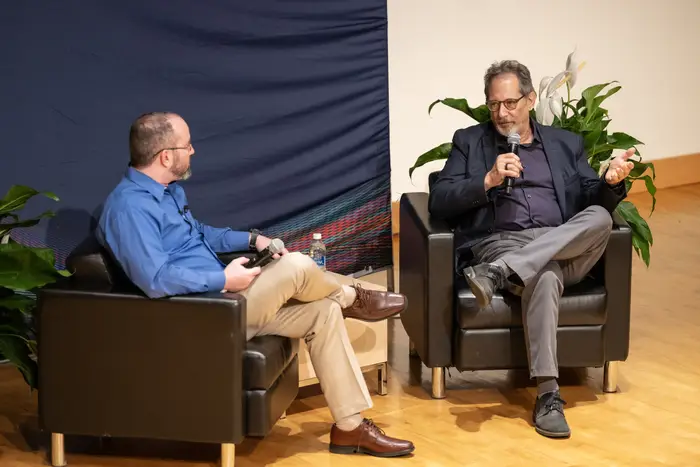
“Carnegie Mellon is actively innovating and experimenting with how we can use the new AI to help teachers, students, and educational institutions in general. We are just at the beginning of this revolution, but already finding that AI can help teachers allocate their time to the students who are actually in need of help, help students tailor learning experiences to their goals, and provide students with an intelligently supportive problem solving environment, all things which demonstrably improve learning outcomes as well as student enjoyment,” said Richard Scheines(opens in new window), University Professor of Philosophy and dean emeritus in the Dietrich College.
Carnegie Mellon-developed technologies support manufacturing, agriculture and energy systems. Its work at Mill 19 and the newly opened Robotics Innovation Center(opens in new window) is modernizing industrial work using AI, robotics and mixed-reality(opens in new window) to enhance the safety and productivity of the future workforce.
CMU’s Software Engineering Institute (SEI) is working to rethink cybersecurity for modern defense, and a CMU study identified strengths and challenges in the Pentagon’s software modernization efforts. CMU and its military partners are building the knowledge, tools and talent required to meet new challenges(opens in new window), expanding upon the decades of collaboration stretching back to the first and second world war.
Carnegie Mellon University will play a central role in a new U.S. National Science Foundation (NSF) Regional Innovation Engine designed to strengthen energy technology, manufacturing competitiveness and economic opportunity across Appalachia. Its AI Science Foundry was selected by the NSF to help build national infrastructure for AI-enabled scientific discovery, reducing the distance between research breakthroughs and deployment. University researchers working with partners and collaborators at Department of Energy national laboratories and other universities, are leading three projects selected for funding through the U.S. Department of Energy's (DOE) Genesis Mission, positioning CMU at the forefront of a national effort to transform how scientific breakthroughs are made.
As the future unfolds, advice from a historian can be prescient.
“One of the pitches I make if you study history is you’ll grow a profound sense of possibility about the future, because it’s never set in stone,” Phillips said. “People in one year had no idea how the world would look 20 years later. Instilling that possibility is one of the joys of teaching history.”