How New Artificial Lung Technology Could Change the Game for Chronic Lung Disease
Media Inquiries
Long-term medical treatment for chronic lung disease has stumped doctors and scientists for years. Now, researchers from Carnegie Mellon University have created new artificial lung technology that could drastically change health outcomes and quality of life for patients across the country.
The support and guidance it received during that time from CMU’s technology transfer team in collaboration with the regional life sciences program, Life X, has been one of the key components of the company’s success.
The device, developed by the CMU spinoff company Advanced Respiratory Technologies, could be used in hospital settings in as little as a few years — a short timeline for a biomedical engineering challenge the team of researchers have been focused on solving for well over a decade.

“If you have chronic cardiac disease or heart failure, you can get an artificial heart or a ventricular assist device. If you have chronic kidney disease and you have kidney failure you can be put on dialysis. For the lungs, there’s been absolutely nothing until now,” said Keith Cook(opens in new window), the David Edward Schramm Professor and head of the Department of Biomedical Engineering(opens in new window) in the College of Engineering(opens in new window).
According to the American Lung Association(opens in new window), there were more than 335,000 hospitalizations in the U.S. in 2020 that could be attributed to a chronic obstructive pulmonary disease (COPD) diagnosis. COPD is a term used for a collection of disease characteristics that include emphysema and bronchitis.
“What really motivates me to pursue this project are all of the patients who have chronic lung disease who write me and say, ‘I have chronic lung disease and I cannot be transplanted.’ Or, ‘I only have this much time left, where are you on this technology?’ We work on the device for those patients,” said Cook, who is also founder and chief strategy officer at Advanced Respiratory Technologies.
Inventing a new way to help patients breathe
The lungs work by pulling oxygen into the body’s bloodstream and pushing out unneeded, potentially harmful carbon dioxide. When the lungs can’t function properly, intervention is vital.
Most people who have watched a medical drama on TV can probably picture what that traditionally looks like: A doctor quickly inserts a tube down the sedated patient’s throat and air is mechanically pumped in and out using a ventilator.

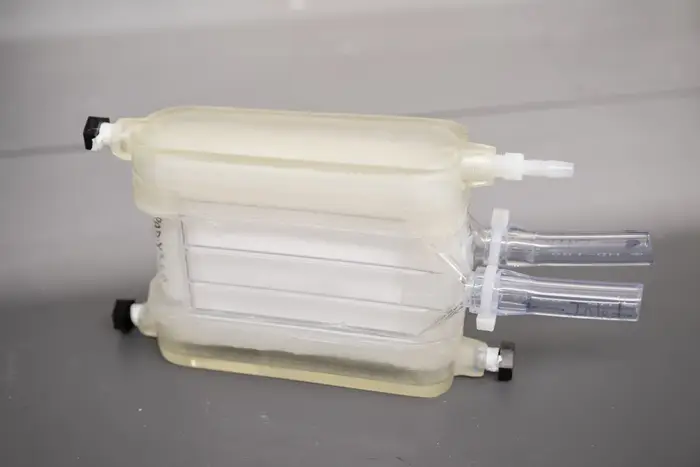
The pulmonary assist system developed by Advanced Respiratory Technologies(opens in new window) (ART) uses an entirely different system. It pulls oxygen into the body and cycles carbon dioxide out of the body without an invasive ventilator. Instead of pumping the lungs mechanically, the device focuses exclusively on circulating the blood. To do that, plastic tubes are inserted into the patient’s neck or chest, which then pumps the patient’s blood through an external device that removes carbon dioxide and oxygenates the blood before returning it to the body.
“We are focused on creating a device that is highly portable and highly blood compatible,” said founder David Skoog, chief scientific officer and founder of ART, who completed his Ph.D. studies at CMU’s College of Engineering. “The combination of those two things allow us to treat these patients in a much simpler fashion. Our long-term goal is trying to use this device as an alternative to lung transplantation.”
Skoog believes the technology is not only less invasive for patients, but will reduce unintended harm and patient discomfort in the long run.
“Mechanical ventilation damages lungs over time because it forces positive pressure into the lung — it’s just inevitable,” he said. “Our technology takes the blood out of the body and doesn’t force air in and out of the lung. It really is a positive alternative to mechanical ventilation.”
The device allows patients relying on it to be fully awake, eat on their own and move independently.
“Being able to get up and walk around and avoid the negative side effects of sedations was really important to us as we developed this technology,” Skoog said. “That shift in quality of life can have a profound effect on patients.”
A multipronged solution to a complex problem
The successful development of the device didn’t come without major hurdles. One of the biggest problems Cook and Skoog had to deal with was the reality that blood naturally begins to clot when it encounters any artificial or foreign material. Biologically, it’s a response that’s meant to help save a person’s life — if blood encounters an unknown object, it immediately clots to slow blood flow and prevent the body from bleeding out and dying.
“It’s an evolutionary response mechanism for getting shot with an arrow,” Cook said. “You want to stop bleeding around those wounds.”
But that biological instinct becomes a problem when the foreign object is the plastic components of an artificial lung meant to save the patient’s life.
To solve this challenge, the researchers designed the device to be as compact as possible, reducing the surface area the blood would touch and possibly react to. They also created a bioengineered material that coats the device’s surface. Blood chemically reacts to this coating in the same way it reacts to water and doesn’t clot.
“For many years, researchers thought there would be one technology that takes care of everything,” Cook said. “But we’ve given up on that concept. We don’t think there’s a silver bullet, but we do think that if you layer multiple technologies on top of each other, there will be an outsized positive effect on clot formation in the device. And that’s what’s happened.”
The partnerships that paved the way to success
The research team at Advanced Respiratory Technologies have been working on the artificial lung device for more than a decade. Turning that research into a company capable of moving the technology toward patients required more than scientific progress. It also required entrepreneurial training, commercialization expertise, funding and connections — support the founders found through Carnegie Mellon’s innovation and entrepreneurship ecosystem.
At CMU, Skoog found support as a 2015 Innovation Commercialization(opens in new window) Fellow at the Swartz Center for Entrepreneurship (opens in new window)when he was a Ph.D. student working on artificial lung development. He was also a member of the National Science Foundation Innovation Corps(opens in new window) (I-Corps) program, which helps university researchers investigate the commercial potential of STEM-related technologies.
“That was a highly positive experience in that it provided entrepreneurial training as we spun out the company,” Skoog said.
The team also received $24 million in federal support(opens in new window) in years past from the U.S. Department of Defense, the Defense Advanced Research Projects Agency and the National Institutes of Health, because the technology offers potentially life-saving treatment for veterans — who are known to have a higher rate(opens in new window) of chronic lung disease. Additionally, their technology could save the lives of wounded soldiers on the battlefield.

“Wounded soldiers who really need portable life support to make it away from the battlefield alive could benefit from our device,” Cook said. “A small, portable and lightweight artificial lung system is fantastic for attaching to someone on a gurney and then flying them out of danger.”
This spring, Advanced Respiratory Technologies joined the LifeX(opens in new window) Accelerator, a program offered by the Pittsburgh-based organization aimed at strengthening commercial readiness of startups in the life sciences.
“We are very fortunate to have local champions and supporters of our startups,” said Cindy Chepanoske(opens in new window), director of technology licensing at CMU’s Center for Technology Transfer and Enterprise Creation (CTTEC).
“CTTEC works with LifeX and similar organizations in a number of ways, sometimes through regular calls such that our partners can identify teams where they can provide their specialized expertise and guidance. We collaborate to bring these early companies forward for accelerator programs, funding opportunities, and the chance to showcase and pitch their ideas.”
ART’s artificial lung still needs approval from the U.S. Food and Drug administration (FDA).
“Our goal is to bring this technology into the hospital in the next 18 to 24 months,” Skoog said. “It is an FDA-regulated medical device and there are a range of tests we need to perform to gain FDA clearance. The good thing is we have a nice, clear 510(k) pathway through the FDA to do exactly that.”
Keith Cook is excited about that timeline.
“Oftentimes, we have no idea how long a piece of biomedical technology will take to get on the market,” Cook said. “Of course, there are things we can’t control in the process. But for the first time, we have a real time frame for this that can make an enormous difference for patients.”
Bio+Health Summit
The Bio+Health Summit held during CMU Startup Week on Wednesday featured research and innovation at the critical intersection of AI and healthcare driven by Pittsburgh companies.