
CMU Undergraduates Balance Learning, Entrepreneurship and Innovation
Media Inquiries
Through the Swartz Center for Entrepreneurship(opens in new window), Carnegie Mellon University provides tools and mentorship for students pursuing ventures in entrepreneurship and business development, helping to drive economic growth in the region and beyond.
“Carnegie Mellon students are building solutions with the potential to strengthen our region and shape industries,” said Damion Shelton, associate vice president and executive director of the Swartz Center. “The Swartz Center helps them turn that ambition into action by connecting them with the guidance, resources and entrepreneurial community they need to test their ideas and move them forward.”
For CMU students, that support extends beyond launching a venture; it builds skills they can carry into any field.
“Carnegie Mellon students, no matter what school or degree program they hail from, are builders. And the students who start entrepreneurial ventures are the brave souls who build something, put it in front of users who do not have to be polite about it, and iterate, and iterate until they have a viable solution. In the age of AI, this ability to find opportunity in uncertainty, to iterate, to take risks and bet on themselves is one of the most durable gifts we can send our graduates out with, whether they go on to start a company, run a lab, write policy or make art,” said Meredith Meyer Grelli(opens in new window), CMU's inaugural vice provost for entrepreneurship and associate vice president.
While business ideas at Carnegie Mellon often form after years of research by accomplished faculty and alumni, undergraduates also strive to turn their ideas into reality, learning to pitch and execute their ideas to the market while earning degrees.
Making time for success

For information systems(opens in new window) major Poom Eamsobhana and computer science(opens in new window) major Parin Pengpun, their product Haru, which uses artificial intelligence for personal scheduling, is both a reflection of their experiences at CMU, and their willingness to explore and engage beyond the lecture hall.
Eamsobhana and Pengpun want to differentiate Haru by taking a different approach to calendar use. Most modern scheduling applications with AI interfaces are structured to give the calendar itself precedence. But Haru is intended to act as a long-term interactive log — one that draws from multiple sources of information, including the user’s calendar — to develop a responsive, living schedule at any time.
“Haru compares the goals you say out loud against the week you actually lived, and shows me the gap kindly like someone on my side, never a scold,” Pengpun said. “Haru reads my life, and can rebuild any view of it at any time.” With this, they explain, the process becomes interactive, allowing users to speak directly to the interface, see potential scheduling changes and outcomes, and give explicit approval before reorganizing the day.
For Eamsobhana, co-founding the business and developing Haru as a product has involved juggling coursework, extracurriculars and an internship, something that he said Haru itself has helped him navigate.
“I think very simply, it boils down to our experience as students,” Eamsobhana said. “We're all overachievers here at CMU. Just as students, there are so many clubs and so many activities that you want to do,” Eamsobhana said. “We all try to pack everything into our schedule. You try to balance your time, trying to check all your messaging apps every few minutes to see, ‘Hey, is there a new update? Oh, did some plans change?’”
Pengpun said the core mission of Haru is to reduce this friction, allowing anyone, not just students, to do more with their time. “The problem of having more ideas than we can remember is universal. Student scheduling was just one instance of that.”
Eamsobhana and Pengpun placed fourth alongside team members Iris Hao and Jazzmin Abarentos in the Deloitte Consulting National Undergraduate Case Competition(opens in new window), which invites undergraduates from various universities to apply their skills to real-world business challenges.
Eamsobhana said that the competitive business experiences helped to set him on his preferred path, inspiring a pivot from the business major to his current information systems degree program. “I didn't want to give up the people skills, the networking skills, that I was learning in business, but I also wanted to do a lot more CS. The IS major combines both aspects.”
Undergraduate excellence at the industry scale

Similarly, Sam Parks, a rising senior studying business and human-computer interaction, said that CMU has served as a strong environment in which to develop his co-founded business RapidEye.
Together with Rohan Nagabhirava, a master’s student in electrical and computer engineering(opens in new window), Parks co-founded RapidEye. The company gives property owners access to computer-vision technology (the same kind used in robotics) to automatically scan buildings and homes for issues that manual inspections may miss.
“The same advancements that are happening for self-driving cars and vision for robot factories with object detection are the same technology in our product,” Parks said.
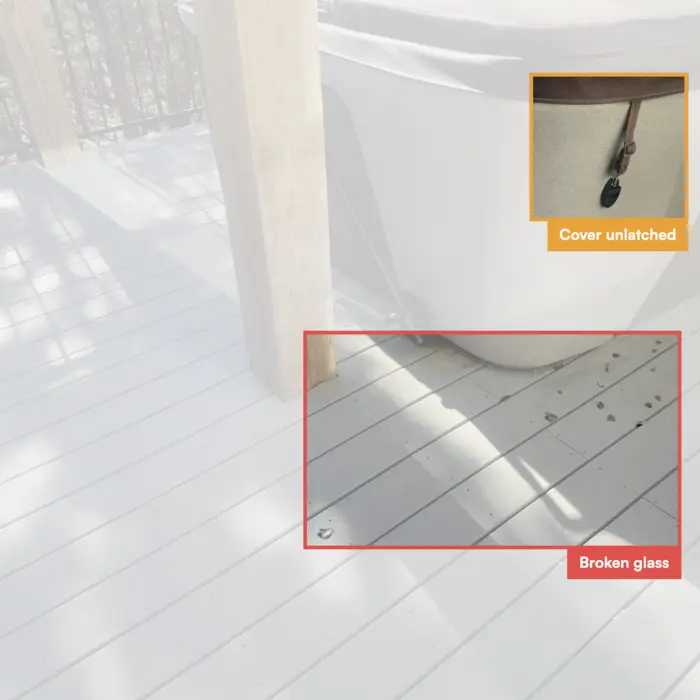
How the technology is applied depends on the needs of each property management company they work with, which administer anywhere from 20 to 1,000 properties. Learning the needs of each partner, he said, has been a process of trial and error. “We're deployed on 3,000 properties total now,” Parks said. “For some property management companies, we figure out what works together. Other companies are hands-off.”
Working on RapidEye has allowed him to draw on his original business major and his recent addition of human-computer interaction(opens in new window) studies. He said both the computational and interpersonal elements prove useful, in different ways, on a daily basis. For instance, Parks found that AI assistants like Anthropic’s Claude model proved useful in certain situations, but not all of them.
Originally, the process centered on “I think something that I wanted to work really badly at the beginning was to give everything I had to do to Claude and see how much I could automate. I’d want to have Claude write all my cold emails and see if it can get people to respond and learn by itself,” he said. “What I figured out was this is actually a terrible strategy. People still like that human connection when they get a cold email or get on a call. People want to feel like they're talking to a human, and when they detect it's AI, they just completely go blank.”
Learning what method works best for each use case, he said, has required striking a balance between the more technical and theoretical coursework and daily on-the-ground business interactions. “Being a founder is almost the highest leverage thing you can do, because you can use these tools to their full potential, and you can just experiment with them.”
Expanding opportunity at every level
Not all student entrepreneurs call the Tepper School of Business their academic home, but students from across the CMU’s seven schools and colleges can bring their ideas to the Swartz Center to potentially make them a reality.
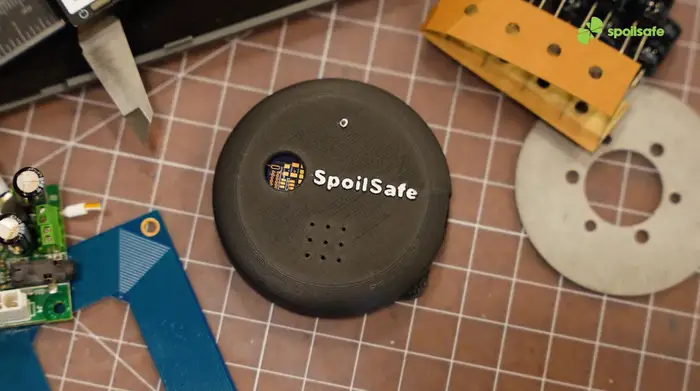
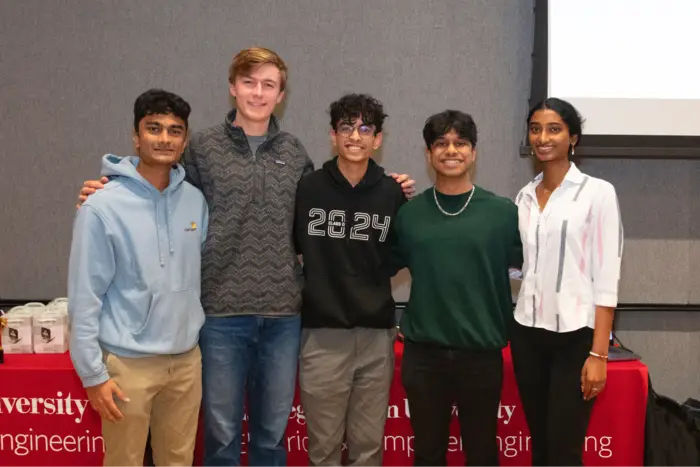
This is the case with SpoilSafe, a food-preservation technology company founded by five CMU engineering students: Rohan Ganesh, Troy McBride, Aneesh Pataballa, Vivaan Sawant and Advika Vuppala.
SpoilSafe is a predictive freshness intelligence platform for cold chain operators. “We use pallet-level environmental sensors to detect the early signs of spoilage before it happens, so warehouses and distributors can decide in real time whether to keep, discount or pull inventory,” Ganesh said.
Developing the technology behind their work drew on their collective expertise in biomedical engineering, electrical and computer engineering, and robotics. The result was the development of small form-factor devices that can capture chemical and environmental signatures of spoilage in perishables.

“Once we built it and looked at where the real scale of the issue lived, it pointed us upstream to warehouses and distribution, where most loss happens before a consumer ever sees the product,” Vuppala said. “That's when it became a B2B company.”
It was, according to the team, just as much of a personal mission as it was a business plan.
“As a team with roots in family farms, we've seen firsthand how much work goes into growing food,” Ganesh said. “So when I learned that over a trillion dollars of food is wasted globally every year, and that fourteen percent of shipments never make it from harvest to retail, it felt like watching all of that effort get thrown away. And the place where most of that loss happens isn't the farm. It's the warehouse.”
For the team, their desire to see sustainable outcomes eventually led them to collaborate on the project and seek out institutional support at Carnegie Mellon. The team sought help and guidance from the on-campus Project Olympus incubator, as well as additional resources from the Swartz center such as the Spark grant.

The center also provides support to students with the Undergraduates Innovation Scholars program, which has accepted 121 applicants since 2016. Graduate students also have the opportunity to apply for the James R. Swartz Entrepreneurial Fellowship. Two hundred and forty-eight graduate-level students have been accepted in this program since 2005, with 12 additional students who will be selected this fall.
“The Swartz Center has been invaluable to our journey as founders,” Ganesh said. “Right from the start, joining the Project Olympus initiative pushed us to get out and talk to customers about their real experiences with food loss, and it connected us with mentors who helped us refine the idea. Throughout this past year we've had constant support from the entrepreneurs in residence and faculty. They gave us a table in the fall semester, and by the spring we had a startup garage to work out of as the business kept growing.”
Strengthening entrepreneurship across the region
The student projects serve as a broader surge of entrepreneurial activity across AI, robotics and science at CMU and throughout Pittsburgh. During CMU Startup Week(opens in new window), students, faculty, alumni, investors and community partners can connect with founders, explore emerging ventures and learn how to take their own ideas forward.
Similar innovations from the Carnegie Mellon community are being showcased as part of CMU Startup Week, coinciding with StartUP PGH(opens in new window), a week-long showcase highlighting the region as an anchor for entrepreneurship, innovation, and frontier technologies. Explore the CMU Startup Week schedule and join CMU’s community of builders, mentors and supporters.


