
2026 Andy Awards Recognize CMU Staff for Outstanding Work
Media Inquiries
Carnegie Mellon University recognized seven staff members and two teams for their significant contributions at the 32nd annual Andy Awards ceremony Oct. 14 in the Rangos Ballroom at the Cohon University Center.
Named for Andrew Carnegie and Andrew Mellon, the Andy Awards recognize the legacy forged by CMU staff members through their hard work. This year’s nominees consisted of 53 individuals and 19 teams representing an array of departments, functions and responsibilities across the university.
Also during the ceremony, Staff Council recognized 49 individuals celebrating 30 or more years of service to the university with Staff Service Awards.
The 2026 Andy Award winners are:
- Commitment to Community Engagement: Carole Panno
- Commitment to Excellence (Rookie*): Margaret McGill
- Commitment to Excellence (Veteran**): Sandra DeVincent Wolf
- Commitment to Students: Diffy Paljevic
- Commitment to Vibrant Community: Crystal Johnson
- Innovative and Creative Contributions: Jonathan Kiritharan
- Spirit: Joseph Beaman
- Teamwork and Collaboration (Special Project): Student Affairs Room Inspection App Team
- Teamwork and Collaboration (Standing): Carnegie Mellon Qatar Crisis/Emergency Preparedness and Response Team
*recognizes staff who have been at CMU for fewer than three years
**recognizes staff who have been at CMU for three or more years
Commitment to Community Engagement
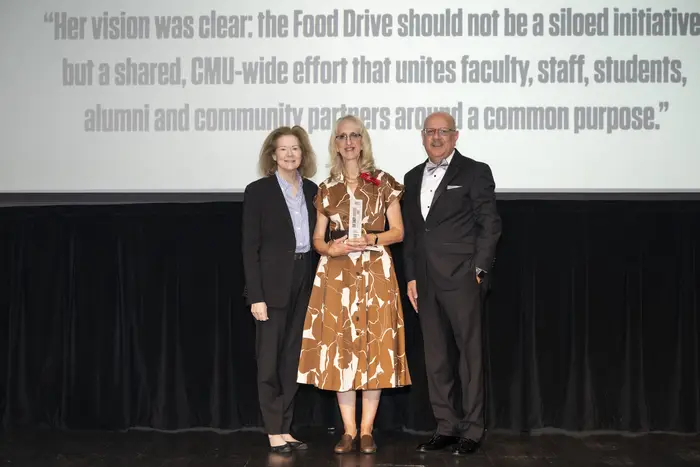
Carole Panno
Associate director of development, University Advancement
Carole Panno has spent more than three decades turning Carnegie Mellon’s commitment to community engagement into meaningful action, forging lasting connections between the university and the people it serves.
Through her leadership, vision and dedication, she has helped make the annual Food Drive a defining expression of the university’s civic mission and a model for community partnership across the Pittsburgh region.
"Carole is a community champion, bridging the gap between our campus and the neighbors who surround it," said Jim Garrett, provost and chief academic officer.
As longtime chair of the Staff Council Food Drive Committee, Panno has guided one of the university's most impactful charitable initiatives. Her leadership reached new heights in 2025 when, in recognition of CMU’s 125th anniversary, she set an ambitious goal of raising $125,000 for Greater Pittsburgh Community Food Bank.
The campaign exceeded expectations, raising a record-breaking $125,910, collecting more than 2,000 pounds of food and essential items, and providing 265 can openers to support the CMU Pantry.
"That success would not have been possible without Carole’s leadership, passion and tenacity," said Jennifer Zgurich, director of corporate and community giving for Greater Pittsburgh Community Food Bank.
Garrett, who has served as honorary co-chair of the Food Drive for several years, said Panno’s work exemplifies CMU’s mission to impact society in a transformative way — regionally, nationally and globally.
"While many focus on the final metrics, the thousands of pounds of food and tens of thousands of dollars raised, I see the sophisticated, tireless operation Carole runs," Garrett said. "She manages a complex network of volunteers, navigates the logistical hurdles of our campus, and maintains a relentless momentum that ensures we consistently meet and often exceed our goals."
What made the 2025 Food Drive particularly impactful was not just the outcome, but how Panno achieved it. To increase visibility and strengthen participation, the drive began earlier and lasted longer, stretching from Oct. 1 into early November and culminating at the Benefits Fair and Homecoming. She introduced new outreach strategies, including the use of CMU Police Department mobile light-up signage to promote the drive across campus.
As a way to connect donors with the cause, Panno organized a visit for university leaders to the Greater Pittsburgh Community Food Bank. She also strengthened existing initiatives such as Drive and Drop sites and expanded team-based participation.
"Her vision was clear: the Food Drive should not be a siloed initiative, but a shared, CMU-wide effort that unites faculty, staff, students, alumni and community partners around a common purpose," said Ryan Freytag, director of Alumni and Constituent Engagement.
Commitment to Excellence (Rookie)
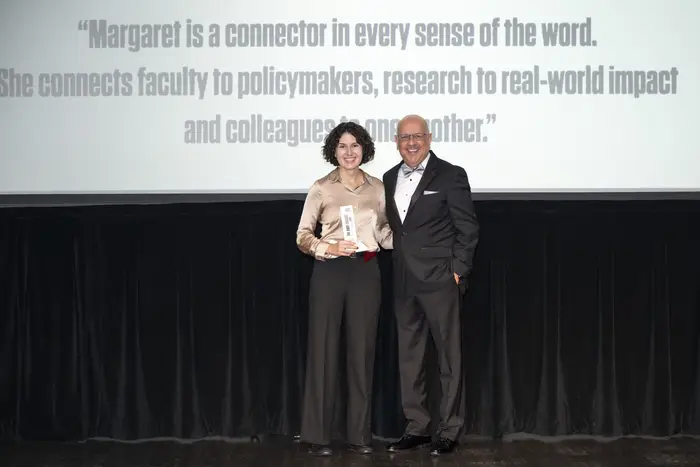
Margaret McGill
Director of policy engagement, Office of Government Relations
Operating primarily from her office in Washington, D.C., Margaret McGill serves as a link between university researchers, federal decision-makers and national media, amplifying Carnegie Mellon’s innovations on the national stage.
"Margaret has demonstrated an extraordinary dedication to quality, an infectious upbeat attitude and a relentless drive to deliver outstanding results," said Daniel Tkacik, executive director of the Wilton E. Scott Institute for Energy Innovation. "Her landmark work at the intersection of energy policy, academic synthesis and high-level stakeholder engagement has positioned the university at the center of national energy innovation dialogue."
McGill’s knack for translating dense, technical research into accessible policy briefs was showcased during the inaugural Energy and Innovation Summit, held at CMU in July 2025.
Coordinating more than 30 faculty and staff members across disciplines, she led the synthesis of 29 research memos on the intersection of AI and energy. The memos served as the summit's intellectual foundation and showcased CMU’s real-world impact. Their influence was so significant that President Farnam Jahanian frequently cites them as examples of university leadership.
"Margaret’s role demands creativity, energy and enthusiasm," said Tim McNulty, associate vice president for Government Relations. "Most critically, it demands a deep recognition of the power of the policy research of CMU faculty to make a difference in addressing the most pressing challenges facing the nation."
During CMU Energy Week 2026, McGill led the development of a series of Scott Institute research memos on grid innovation. Working under tight timelines and coordinating feedback from dozens of senior researchers, she created an efficient review process that kept projects on track while maintaining the highest standards of accuracy.
At AI and Energy: A CMU Community Summit, she guided discussions among more than 200 students, faculty and staff as they shaped the university’s research priorities.
Whether stepping in as an Energy Week panelist or coordinating university responses to federal requests for information, McGill approaches every challenge with optimism and creative problem-solving.
"Margaret is a connector in every sense of the word," said Costa Samaras, director of the Scott Institute. "She connects faculty to policymakers, research to real-world impact and colleagues to one another."
Commitment to Excellence (Veteran)
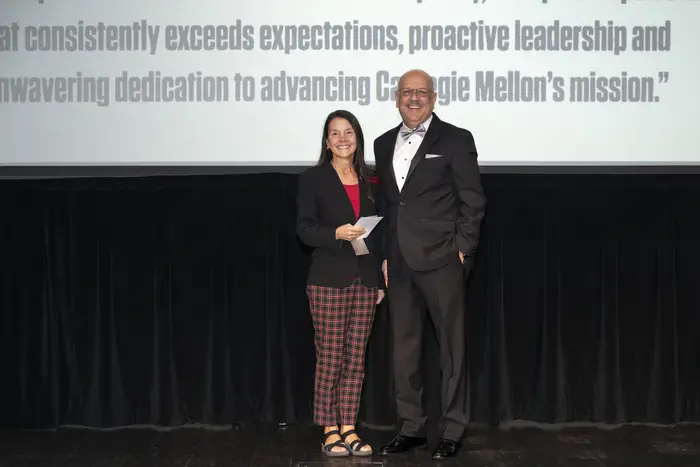
Sandra DeVincent Wolf
Executive director, Manufacturing Futures Institute and Next Manufacturing Center
Sandra DeVincent Wolf’s leadership has helped position Carnegie Mellon as a leader in additive manufacturing, innovation and workforce development.
"Sandra has put CMU on the map in the field of advanced manufacturing," said Anthony Rollett, U.S. Steel Professor of Metallurgical Engineering and Materials Science and faculty co-director of the Next Manufacturing Center.
Since joining the Next Manufacturing Center in 2016, Wolf has helped build a vibrant community of nearly 100 faculty researchers, students and industry partners. She guided the development of manufacturing research facilities on the Pittsburgh campus and at Mill 19, launched innovative educational programs, secured key partnerships and created new opportunities that connect research with real-world challenges.
With a background in materials science, Wolf bridges the worlds of research, industry and education. Colleagues point to her skill in building partnerships, identifying solutions and bringing the right people together to move complex projects forward.
When CMU sought to equip a new research facility at Mill 19, Wolf led negotiations for a custom manufacturing system. She worked through seven versions of the proposal and reduced the cost from $1 million to $650,000 without diminishing the facility's capabilities.
She guided the Manufacturing Futures Institute (MFI) through an extensive strategic planning effort that established the MFI 2030 vision, a roadmap for the institute's future research, educational and industry engagement priorities.
"Sandra exemplifies a relentless commitment to quality, exceptional performance that consistently exceeds expectations, proactive leadership and unwavering dedication to advancing Carnegie Mellon’s mission," said Gary Fedder, faculty director of MFI.
An adjunct professor in the Department of Materials Science and Engineering, Wolf co-designed and launched CMU’s undergraduate minor in additive manufacturing and taught its hands-on laboratory course. She also facilitated the annual 3D Bioprinting Open Source Workshop, which draws researchers from around the world to learn and collaborate.
Serving on advisory groups such as America Makes and ASM International, Wolf elevates the university's visibility while championing workforce development programs that inspire middle school students, adult learners and regional partners. In August, she received an Ambassador Award from America Makes.
For many across campus, Wolf has made her greatest impact through mentorship. She serves on Ph.D. thesis committees and maintains an open door for students navigating career paths and job offers.
"Sandra is committed not only to her own excellence, but also the excellence of those around her," said Bryan Webler, professor of materials science and engineering and co-director of the Center for Iron and Steelmaking Research. "She makes this place and its people better."
Commitment to Students
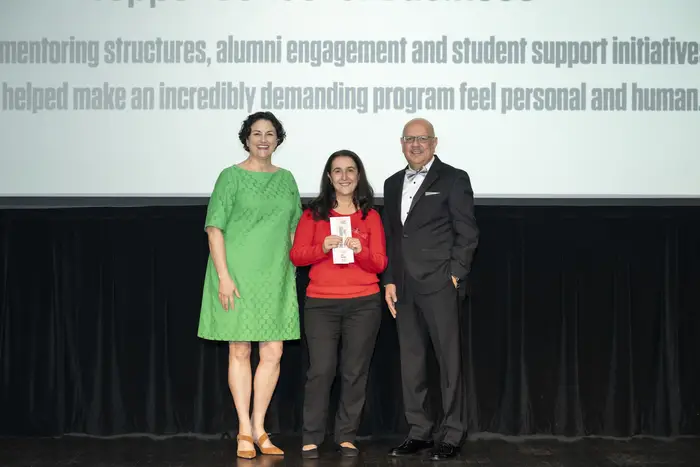
Diffy Paljevic
Director, Master of Science in Computational Finance program, Tepper School of Business
For more than 20 years, Diffy Paljevic has led the Master of Science in Computational Finance (MSCF) program in New York City. Her role extends beyond academic advising and alumni relations.
"She has been one of the most important contributors to the success, culture and reputation of the program," said MSCF Executive Director Robert Simon. "Over the years, I have watched Diffy help students through visa crises, medical emergencies, family tragedies, academic setbacks, recruiting disappointments and personal struggles."
Paljevic has transformed a satellite location into a close-knit community where students feel supported, valued and connected.
"She brings the student community together as a family," said MSCF alumna Sonali Kapoor.
For international students, who make up roughly 80% of the MSCF cohort, Paljevic often is a guide during their transition to life in the United States. Current student Nisha Sen recalled how Paljevic made an immediate impression on Admitted Students Day.
"I knew she would be a pivotal figure in this next chapter of my life," Sen said. "She was a key reason I chose Carnegie Mellon’s MSCF program over the other programs I was admitted to."
Her impact extends well beyond orientation. Recognizing that international students and those adapting to a new academic culture may hesitate to approach professors, Paljevic spots warning signs and offers proactive support.
Ka-Wo Chen, a 2013 MSCF graduate who went on to become a software engineer at Google, experienced that advocacy firsthand when he and several classmates felt overwhelmed by coursework.
"We would not have survived the program by our own efforts had Diffy not been constantly coordinating with our professors," Chen said.
Paljevic’s dedication shines brightest during times of crisis. When Hurricane Sandy struck New York in 2012, Paljevic called students to ensure they were safe. As the city recovered, she secured temporary office space so classes could continue and helped students displaced by floodwaters find temporary housing and supplies.
Beyond day-to-day advising, Paljevic has shaped some of the program’s signature initiatives. She was the primary architect of the Quant-in-Residence program, which pairs students with alumni mentors, and helped launch the Women in Quant Finance Club in December 2024.
"Through mentoring structures, alumni engagement and student support initiatives, Diffy has helped make an incredibly demanding program feel personal and human," Simon said. "In New York, where students are geographically separated from the main Pittsburgh campus, she has effectively built a second home for our students."
Commitment to Vibrant Community
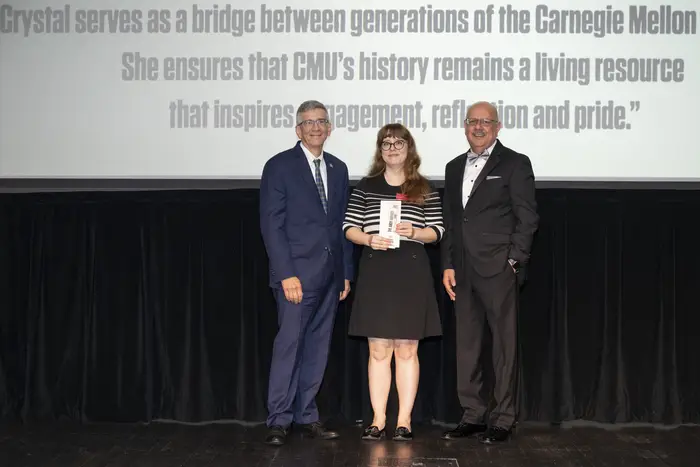
Crystal Johnson
Community collections archivist, University Libraries
Crystal Johnson has transformed the University Archives from a traditional research space into a vibrant center for connection, belonging and discovery. Through innovative programming, collaborative partnerships and a commitment to inclusion, she ensures that CMU's history is preserved and actively used to strengthen the university community.
"She is always asking how the archives can serve the broader community rather than how the community can serve the archives," said Julia Corrin, the Michael and Lonna Smith University Archivist and associate dean for distinctive collections.
That philosophy shapes every aspect of Johnson’s work, from classroom instruction and student mentorship to campus-wide events that invite participants to see themselves as part of CMU’s ongoing story.
"These programs do more than celebrate the past," said Sarah Bender, CMU Libraries senior communications coordinator. "They create new memories and traditions that strengthen the fabric of the Carnegie Mellon community."
During the 2025-26 academic year, Johnson organized 16 classes and 7 events that engaged nearly 900 students, faculty and staff members. These experiences introduced participants to archival research and fostered meaningful connections to one another and to the institution.
Students describe Johnson’s programs as transformative. One participant called an archives visit "the most meaningful class session I have had at CMU in my first semester here," while another noted that seeing “students who look like me in our history means a lot."
Johnson’s creativity and vision are evident in programs such as the Hands-On event series, which brings people together through making, learning and shared experiences. For Hands-On: Pizza & Pennant Making, held in conjunction with the University Archives' 125th anniversary exhibit, more than 125 students gathered in the IDeATe studio to create banners inspired by historic CMU pennants.
"Students who may never have wandered into the archives left that evening knowing each other, knowing the institution's history and knowing Crystal," Corrin said.
Johnson also helped launch the Student Advisory Council’s Archives Ambassadors program, which gave students opportunities to engage with archival collections and contribute to institutional storytelling. She works closely with faculty, diversity centers, student organizations and colleagues across campus.
"Crystal serves as a bridge between generations of the Carnegie Mellon community," Bender said. "Her work preserves the stories, achievements and experiences of students, faculty, staff and alumni while making those stories accessible and relevant to contemporary audiences. She ensures that CMU’s history remains a living resource that inspires engagement, reflection and pride."
Innovative and Creative Contributions
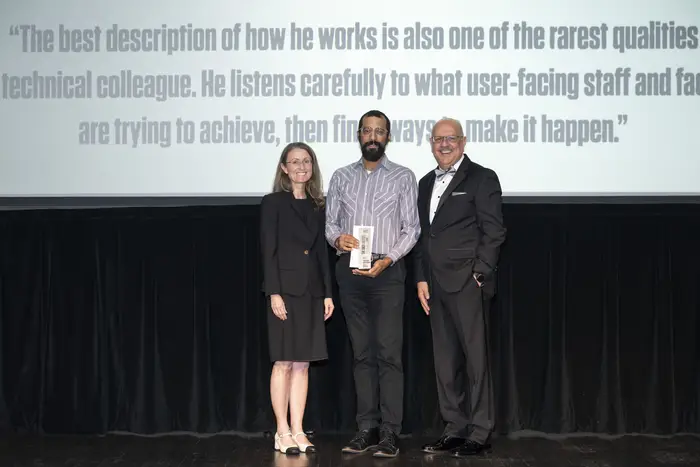
Jonathan Kiritharan
Library systems and applications developer, University Libraries
Colleagues describe Jonathan Kiritharan as a thoughtful problem solver and skilled communicator. He has a knack for understanding what faculty and staff need and turning those insights into tools that help showcase Carnegie Mellon's research to a broader audience.
"The best description of how he works is also one of the rarest qualities in a technical colleague," said Nicky Agate, University Libraries associate dean for academic engagement. "He listens carefully to what user-facing staff and faculty are trying to achieve, then finds ways to make it happen."
Kiritharan’s work supporting open scholarship reflects that approach. Although University Libraries has negotiated 17 open-access agreements with academic publishers, research articles remained scattered across individual journal websites, making it difficult to highlight the full scope of CMU research.
To solve that problem, Kiritharan connected KiltHub, the university’s institutional repository, with OA Switchboard, a nonprofit platform that facilitates information among publishers, institutions and funders. The connection brings research together in one place, making it easier to discover and showcase CMU scholarship.
Working directly with external software developers, Kiritharan created an automated system that imports publisher notifications into KiltHub. The tool automatically generates metadata records linked to full-text articles, eliminating manual entry for authors and library staff.
Since launching in fall 2025, the system has generated more than 520 article records and attracted more than 30,000 views. The project has been so successful that major platform providers plan to make Kiritharan’s integration available to universities worldwide.
Kiritharan brought that same practical, user-focused approach to graduate research infrastructure. To support the university’s unified submission process for the 2025-26 academic year, he built a system that automatically transfers doctoral dissertations from ProQuest into KiltHub. The integration increases the visibility of Ph.D. students’ work by making it available through both commercial and open-access platforms.
"In library technology, there is a constant need to bridge the gap between complex digital systems and everyday users," said Katie Behrman, institutional repository manager. "Jonathan explains technical concepts clearly, anticipates colleagues’ needs and can also speak the specialized language required to collaborate with developers for our external platforms."
By replacing time-consuming manual tasks with automated solutions, Kiritharan continues to modernize campus workflows. His work supports the CMU Strategic Framework and demonstrates how collaboration, innovation and technical expertise can expand CMU’s reach within the global academic community.
Spirit
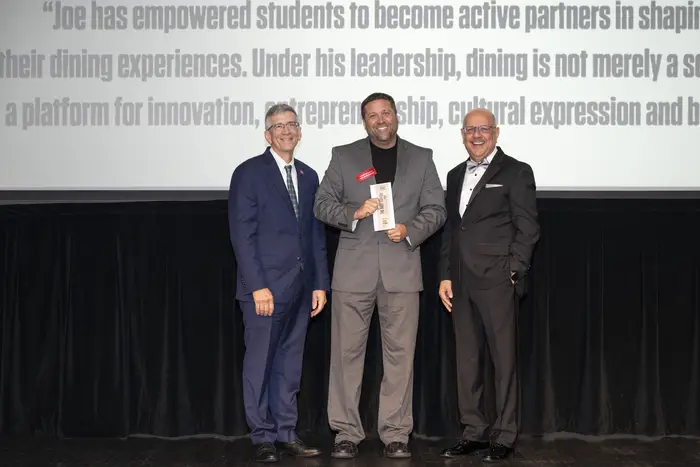
Joseph Beaman
Director of dining services, Student Affairs
Joseph Beaman has transformed the campus dining experience through active engagement and student mentorship. He brings a unique energy to his role, creating opportunities for students and staff alike to innovate and contribute.
"It is hard to capture Joe’s energy in words," said alumnus Lex Capestany, an Andrew Carnegie Society Scholar who founded the Student Dining Advisory Committee. "He brings passion and excitement to every meeting, every conversation, every day. I know few people who match Joe’s constant drive to improve and uplift the people and community around him."
Beaman champions student voices, ensuring they have a meaningful seat at the table. When Capestany approached him with questions and ideas from a Writing About Public Problems course, Beaman was receptive and encouraging. He went on to mentor Capestany for two years through the Dining Student Advisory Committee.
"Despite his full schedule, Joe always made time to meet with me," Capestany said. "When the university was conducting its Housing and Dining Master Plan, Joe supported me every step of the way as I developed a report summarizing student perspectives on dining. Every time I speak with Joe, he is either working on a new student initiative or developing a new idea to improve dining."
Beaman’s commitment to experiential learning led him to create Restaurant Builder, the first CMU course focused on designing and launching student-run restaurant concepts. He built the curriculum from the ground up, a huge undertaking for a first-time instructor, and raised the stakes by having students present their business concepts to university leaders and executives from Chartwells.
"Joe has empowered students to become active partners in shaping their dining experiences," said Jessica Rea, program director of nutrition. "Under his leadership, dining is not merely a service. It is a platform for innovation, entrepreneurship, cultural expression and belonging."
Beaman also served as a strategist and champion for Capital Grains, the student-run restaurant that emerged from the course. Former student co-CEOs Makayla McCreary and Mia Michel recalled how Beaman consistently emphasized how their experiences would translate beyond graduation, regardless of the careers they pursued.
"Listening to Joe speak about the inception and evolution of Capital Grains, you immediately recognize how deeply he believes in the value of hands-on learning for CMU students and how proud he is of their achievements," McCreary said.
With a network of 13 dining vendors, many of which are local family-owned businesses, CMU offers robust dietary and faith-based dining options, and culturally rich menus. Beaman understands the importance of preserving this ecosystem while ensuring it remains operationally excellent and reflective of the community it serves.
"Joe fosters a work climate grounded in curiosity, responsibility and service," Rea said. "His positive attitude and unmistakable CMU pride inspires his team to reach for the stars."
Teamwork and Collaboration (Special Project)
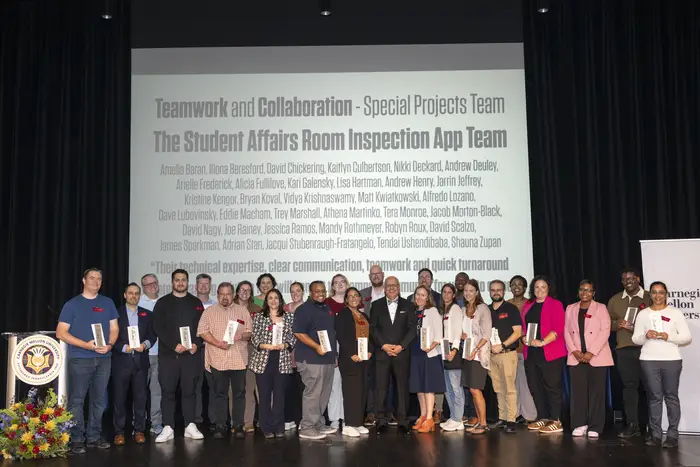
Student Affairs Room Inspection App Team
Computing Services: Vidya Krishnaswamy, software development manager; Dave Lubovinsky, senior systems/software engineer; Adrian Stan, senior systems/software engineer; Trey Marshall, director of administrative and academic solutions; Andrew Deuley, systems and software engineer; Housing Services and the Office of Residential Education: Tera Monroe, associate dean and director of residential education; David Chickering, associate director of residential education; Matt Kwiatkowski, associate director of residential education; Eddie Macham, associate director of residential education; James Sparkman, assistant director of residential education and housefellow for student organization communities; Kaitlyn Culbertson, housefellow and coordinator for residential education; Nikki Deckard, housefellow and coordinator for residential education; Alicia Fullilove, housefellow and coordinator for residential education; Jarrin Jeffrey, housefellow and coordinator of community responsibility; Kristine Kengor, housefellow and assistant director of residential education; Athena Martinko, housefellow and coordinator of residential education; Jacob Morton-Black, housefellow and coordinator of community responsibility; Jessica Ramos, housefellow and coordinator of residential education; Jacqui Stubenraugh-Fratangelo, housefellow and coordinator of residential education; Tendai Ushendibaba, housefellow and coordinator of community responsibility; Shauna Zupan, housefellow and coordinator of residential education; Kari Galensky, administrative assistant, Housing & Residential Education; Lisa Hartman, director of housing services; Andrew Henry, director of facilities; Amelia Baran, senior administrative coordinator; Mandy Rothmeyer, assistant director of facilities; David Nagy, facility coordinator; David Scalzo, facility coordinator; Joe Rainey, facility coordinator; First-Year Orientation and Family Engagement: Arielle Frederick, senior administrative project coordinator; Student Affairs: Alfredo Lozano, director of information technology; Robyn Roux, project administrator; Illona Beresford, senior director of facilities and space planning; Community Health and Well-Being: Bryan Koval, director of student support resources
Preparing campus housing for the start of a new academic year, which includes more than 4,200 beds across 26 residential communities, was once a frantic race against the clock. The room inspection process was a headache of handwritten notes, duplicated spreadsheets and manually-entered data. It was slow, frustrating and left maintenance crews with a narrow window to complete repairs before students arrived each fall.
To fix the problem, this cross-campus team built a simple, custom mobile app that changed how inspections are done. Instead of carrying clipboards, inspectors now enter a room, log issues, snap photos with their phones, and submit repair requests straight into the university's Maximo work management system.
"The team fundamentally transformed a stressful process into a model of operational efficiency and teamwork," said Illona Beresford, senior director of facilities and space planning. "It built a solution that saves time, reduces costs and strengthens collaboration across university departments."
By engaging housefellows and resident advisers and training them to use the new app, the team turned a massive chore into a streamlined, shared effort. The results were immediate: inspections that used to drag on for six weeks were wrapped up in just 16 days.
"This directly improves the student experience by enabling faster response times, clearer accountability and more consistent follow‑up on facility needs," said Tera Monroe, associate dean and director of Residential Education.
The extra time gives maintenance crews a larger window to complete deep cleanings, repairs and upgrades, ensuring thousands of students arrive each fall to a fresh, welcoming home.
"This has long been a goal of the housing team, and it was finally brought to life through the collaboration of many campus partners," said Robyn Roux, project administrator for Student Affairs business and financial operations. "Their technical expertise, clear communication, teamwork and quick turnaround created a lasting solution that will benefit the campus community for years to come."
Teamwork and Collaboration (Standing)
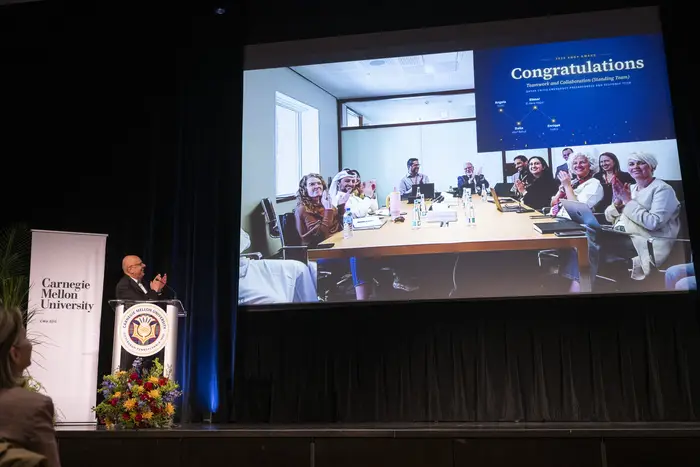
Crisis/Emergency Preparedness and Response Team, CMU-Q
Nasser Alaeddine, chief information officer; Elissar El-Akra Hajjar, director of facilities; Angela Ford, assistant director of communications; Dalia Atef Rehal, associate dean; Fadhel Annan, associate dean; Enrique Isidro, assets and mailing supervisor; Kara Nesimiuk, chief marketing and communications officer; Laith Hammad, manager of government and corporate affairs; Mohammed Khodary, receptionist and administrative coordinator; Rosemarie Florida, manager of auxiliary services
When geopolitical volatility escalated rapidly in February, Carnegie Mellon University in Qatar faced an immense challenge. In response, the CMU-Q Crisis/Emergency Preparedness and Response Team put emergency plans into action and worked through operational hurdles to protect students, faculty and staff.
"While it is easy to talk about organizational values when campus life is running smoothly, true institutional character is revealed when everything hangs in the balance," said Miguel Delgado, associate vice president for Enterprise Risk Management and chief risk officer.
Team members maintained a 24/7 operational presence, monitoring developments, assessing emerging risks and taking swift action to protect the campus community. Alongside physical safety, they also focused on supporting people’s emotional well-being.
"By accounting for every individual, maintaining transparency and serving as a calm, human presence, the team helped steady a worried community and protected the human element of our global campus," Delgado said.
Keeping people safe was only part of the mission. Refusing to let regional instability disrupt students’ education, the team partnered with academic leadership to activate continuity plans. Remote learning and work were quickly expanded, allowing operations to continue with minimal disruption and ensuring a successful end to the semester.
"A defining characteristic of CMU is our collective drive to solve problems and deliver world-class education, regardless of the obstacles," Delgado said. "This team refused to let regional instability compromise our students' futures."
Managing a crisis of this scale required strong collaboration across international borders. The team worked closely with the Pittsburgh campus, the Qatar Foundation, Education City institutions, and American and Qatari government agencies. It navigated complex and often conflicting logistics with respect and professionalism, ensuring all partners were aligned and worked from a shared plan.
By protecting lives, preserving the academic year and strengthening key global partnerships, the team demonstrated what resilient, values-driven leadership looks like in action.
"This team embodied the very best of our institutional values at a moment when they mattered most," said Francisco Molina, senior director of Disaster Recovery and Business Continuity Services.


