
CMU Researchers Outline a Regional Plan for Green Infrastructure
Civil and environmental engineering researchers are partnering with local communities across Allegheny County to develop practical strategies for deploying green infrastructure and strengthening the region’s resilience against extreme weather
Media Inquiries
As climate change brings heavier rainfall, rising temperatures and increased flooding to the Northeast, communities are facing growing strain on infrastructure that wasn’t designed for these extreme conditions. In Allegheny County, home to Carnegie Mellon University and the city of Pittsburgh, steep hillsides, aging stormwater infrastructure and more than 100 municipalities intersect, making these challenges especially urgent, yet increasingly complex to solve.
With support from the National Science Foundation’s Regional Resilience Innovation Incubator (R2I2) program, civil and environmental researchers at Carnegie Mellon are leading a new effort to help the communities in their own backyard respond. The project brings together engineers, scientists, educators and local partners to develop a county-wide climate adaptation strategy to scale “green infrastructure,” or nature-based solutions that work with the environment to mitigate climate impacts.
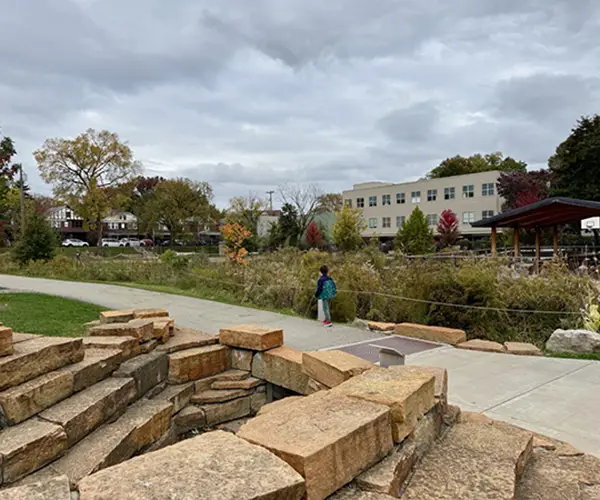
Green infrastructure encompasses systems like rain gardens, native meadows, tree canopies and bioswales that absorb and filter stormwater, reduce urban heat and improve water quality. They can be implemented as an alternative to traditional “gray infrastructure,” or engineered systems like pipes, sewers and treatment plants that are designed to move water quickly, but often at a high financial and environmental cost. Despite its promise, green infrastructure has been difficult to implement at scale due to a range of bureaucratic barriers from limited funding to maintenance capacity.

“The city of Pittsburgh, led by ALCOSAN (the Allegheny County Sanitary Authority), is currently increasing their wastewater treatment plant capacity while also building massive tunnels to store our combined sewer flows,” said David Rounce(opens in new window), associate professor of civil and environmental engineering(opens in new window). “Those multibillion-dollar gray infrastructure problems should prevent that combined sewer flow from discharging into our rivers. But we also have to recognize the value of green infrastructure at smaller scales. It can help reduce the burden on this new system, especially as precipitation gets worse in the future, and provide numerous co-benefits.”
Rounce and Sarah Fakhreddine,(opens in new window) also an assistant professor of civil and environmental engineering, joined an interdisciplinary team to analyze data on flooding, water quality and urban heat to identify where green infrastructure can have the greatest impact. Pilot sites across the county will be monitored using low-cost sensing systems to measure outcomes like stormwater runoff reduction, temperature changes, and improvements in biodiversity and soil health.
At the same time, project partners will work directly with municipal leaders to better understand the challenges they face on the ground. Through community forums and workshops, the team will gather insights on local priorities, policy constraints and resource gaps, ensuring that their proposed solutions are not only effective, but also realistic to implement.

“Stormwater is a persistent challenge to managing water quality and runoff across urban environments, not just in Allegheny County,” said Fakhreddine. “This effort emphasizes engagement, working alongside municipalities to understand barriers and develop tools and knowledge that can be applied locally and ultimately transferred to other regions facing similar challenges.”
Together, these insights will inform a set of practical tools, including a municipal implementation guide and model policies designed to support adoption across different communities. The project will also develop education and communication strategies to help local leaders clearly convey the benefits of green infrastructure, from reducing flood risks to improving neighborhood livability.
By combining data-driven analysis with community-informed design, the team aims to create a comprehensive roadmap for scaling green infrastructure across Allegheny County, enabling widespread adaptation for system-level climate resilience and a model for communities beyond Western Pennsylvania who face similar climate pressures.
“Our goal is to create a replicable framework that municipalities across southwestern Pennsylvania can use to improve resilience to increasing stormwater challenges,” said Sarah States, an affiliate researcher in the Department of Civil and Environmental Engineering and project lead.
“Green infrastructure is a nature-based solution that offers many co-benefits for human and environmental well-being, and we hope that this project can help communities overcome the barriers to implementation.”
The “Bridging Science and Community: Advancing Green Infrastructure for a Resilient Future” project is a collaborative effort between Phipps Conservatory and Botanical Gardens, Carnegie Mellon University, the Congress of Neighboring Communities, J. Sickler Consulting, the Pennsylvania Department of Conservation and Natural Resources, the U.S. Geological Survey, ALCOSAN, University of Pittsburgh Water Collaboratory, Ethos Collaborative and Upstream Pittsburgh.


