
Bacteria Can Learn and Form Memories Without a Brain
Media Inquiries
Researchers at Carnegie Mellon University have shown that bacteria can learn from past experiences, store memories across generations and adapt their behavior to changing environments all without a brain or nervous system. The research could shape how scientists think about bacterial infections and antibiotic treatment.
In a study published in PRX Life(opens in new window), researchers from CMU’s Ray and Stephanie Lane Computational Biology Department(opens in new window) and Mellon College of Science(opens in new window) tracked individual E. coli cells as nutrient conditions shifted between rich and poor environments. Instead of responding the same way every time, the bacteria adjusted their growth based on patterns they had experienced before. Cells exposed to rapidly changing conditions were able to adapt better than cells raised in more stable environments.

The findings suggest bacteria do more than just react to their surroundings. They appear to encode memories of past environments and use those memories to guide future behavior.
“For a long time, people assumed bacterial growth was determined only by the environment the cell is currently experiencing,” said Josiah Kratz, the first author on the paper. “What we showed is that the history of past environments matters. The cells remember those experiences, and that memory changes how they behave.”
Kratz completed most of the work as a Ph.D. student in the joint Computational Biology training program(opens in new window) between Carnegie Mellon and the University of Pittsburgh. He is now a postdoctoral fellow at the Georgia Institute of Technology.
Learning at the single-cell level
To study bacterial behavior, collaborators used a sophisticated microfluidic device known as a “mother machine,” which traps individual bacterial cells inside tiny chambers while scientists continuously observe them under a microscope.
The single-cell approach allowed researchers to rapidly switch cells between nutrient-rich and nutrient-poor environments while measuring how quickly each bacterium grew.
Fangwei Si(opens in new window), the Cooper-Siegel Assistant Professor of Physics, said this technology allowed the team to see how bacterial responses depended on current conditions, but also on how quickly conditions had fluctuated in the past. Cells exposed to fast-changing nutrient cycles adapted more quickly than cells raised in slower cycles.
“Single-cell approaches are powerful,” said Si, who specializes in biophysics, which focuses on understanding living systems in a quantitatively precise way. “As with studying animal behavior, it is more informative to learn from individual animals’ responses than from the whole population’s. Recording individual cells' life trajectories allows us to discover subtle yet fundamental details in their behavior.”
The work builds on earlier studies showing bacteria can retain short-term memories of previous environments.
“We showed that cells can discriminate between different environmental frequencies,” Kratz said. “To do that, they need a more complex memory than anyone had demonstrated before.”
That memory can even persist across generations. For bacteria, a generation could be tens of minutes to hours.
A single E. coli cell may divide every 30 minutes to an hour in nutrient-rich conditions, but proteins produced during stressful conditions can be inherited by daughter and granddaughter cells. Those inherited molecules allow descendants to retain information about environments they never directly experienced.
“If a grandmother cell experienced stress and survived it, the granddaughter cell can behave differently because of that history,” Kratz said.
Implications for human health
Traditionally, researchers assumed bacterial responses to antibiotics depended mainly on the type and concentration of drug patients are given. But if bacteria retain memories of previous stress, their responses may also depend on environmental history — bacteria that previously were exposed to starvation, high or low temperatures, or low doses of antibiotics could react differently to treatments than bacteria without that history.
“If we want to fully understand and predict how bacteria respond to antibiotics, we may need to consider not only what they’re experiencing now, but what they experienced in the past,” Kratz said.
Researchers hope future studies will investigate whether bacteria show similar learning behaviors in response to antibiotics and other environmental stresses beyond nutrients.
The team also believes the behavior may extend beyond E. coli to many other bacterial species.
“Bacteria don’t live in static laboratory conditions in the real world,” Kratz said. “They survive in constantly changing environments like the human gut, soil or plants. Understanding how they adapt to those fluctuations is really fundamental to understanding life at the microbial level.”
In addition to the authors featured above, the research team included Huijing Wang and Shiladitya Banerjee. Banerjee was the study's corresponding author and provided the primary funding support for the research.
Connecting biology and artificial intelligence
The project brought together experiments, theory and computational modeling — a hallmark of biophysics(opens in new window), an interdisciplinary field that uses the tools of physics to understand living systems.
The researchers developed a mathematical model based on known biological processes inside bacterial cells and found that it accurately predicted how cells would respond to changing environments.
The biggest surprise came when the team analyzed the model itself.
“At an abstract level, the way the cell processes information about its environment maps onto the same type of computational architecture AI researchers use for learning problems,” Kratz said. “Biology and artificial intelligence seem to have converged on a similar strategy.”
The findings suggest that learning can emerge through chemical reactions inside a single cell, without a brain.
Under the Microscope
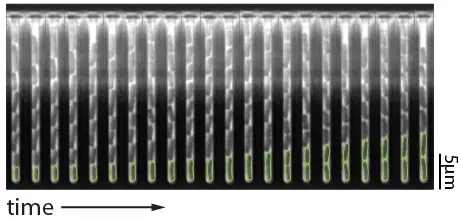
A "mother machine" holds individual bacteria in tiny channels so researchers can watch them grow, divide and adapt to changing conditions over many generations.


